

Let’s be upfront about something, most guides on this topic either scare you with inflated numbers or make it sound easier than it is. Neither is particularly useful. The reality is messier than both and it depends heavily on what kind of book you’re making and what you actually want from it.
So how much does publishing a book cost in 2026? Somewhere between nothing and $5,000-plus. That’s not a cop-out answer, it’s just the truth, and the rest of this guide is about understanding where in that range you’re likely to fall.
The range is wide because there are several ways to publish, self-publishing, traditional, and hybrid, each with different costs and trade-offs.
What you spend, and where, will depend on how serious you are, what kind of readers you’re trying to reach, and frankly, how much you’re willing to do yourself. If you’re trying to figure out the real cost to publish a book, the key is understanding where your money actually goes and which book publishing services are worth every penny.
Average Cost to Publish a Book (Quick Overview)
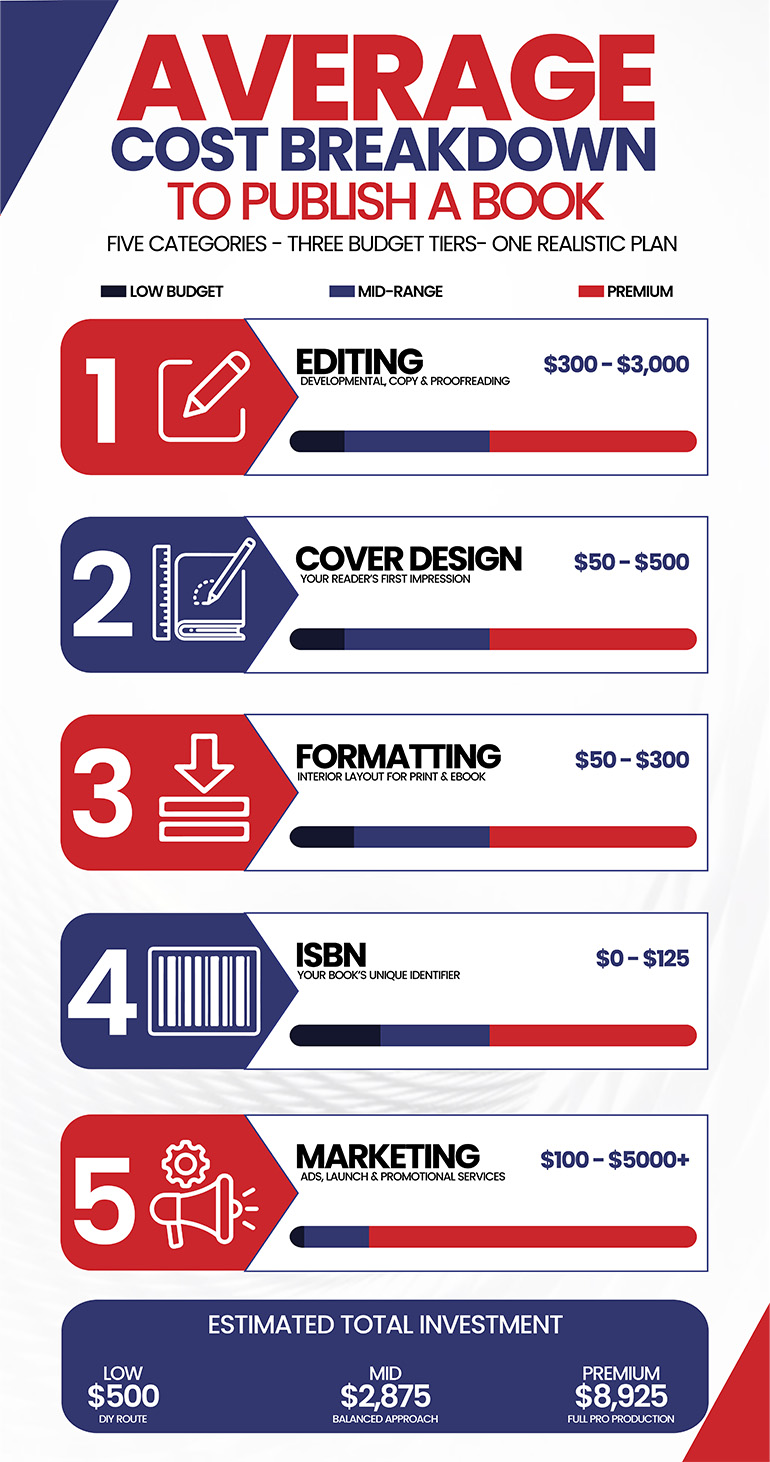
For self-published authors, here’s a rough breakdown of what different parts of the process typically cost:
- Editing: $300 – $3,000
- Cover design: $50 – $500
- Formatting: $50 – $300
- ISBN: $0 – $125
- Marketing: $100 – $5,000+
Some people publish for under $500. Others spend closer to $3,000 and feel every dollar was justified. Neither group is wrong, as it comes down to expectations and goals.
Full Cost Breakdown of Publishing a Book
Editing
This is where I’d tell any first-time author to spend their money if they’re going to spend it anywhere. Not because it’s the most visible part of a book, it isn’t, but because bad editing is noticed.
There are three distinct types worth understanding.
Developmental editing is the deep work. It looks at whether your structure holds up, whether your argument lands, whether the pacing keeps people reading. It’s the most expensive type for a reason.
Copyediting works at the sentence level, cleaning up grammar, flow, and consistency.
Proofreading is the final check before the book goes out, catching whatever slipped through everything else.
Proofreading rates typically run between $0.01 and $0.03 per word. That proofreading cost per word is usually part of broader manuscript editing services, which can vary widely depending on how in-depth the work is, especially when working with professional book editing services. Developmental editing can run several hundred to well over a thousand dollars depending on how much feedback and revision is involved.
Some authors skip developmental editing entirely and use beta readers instead. It can work. But it’s a gamble, and it’s one that shows up in the final product more often than authors expect.
If you’re not writing the book yourself, ghostwriting cost can easily become the largest expense in the entire process.
Cover Design
People really do judge books by their covers and not in a shallow way. A cover tells a reader within seconds whether a book is meant for them. Genre, tone, quality level, all of it communicates through design before a single word is read.
Free tools exist. Canva, for instance, can produce something serviceable. “Serviceable” and “competitive” are two very different things, and in a crowded genre, that gap costs your sales.
Fiverr freelancers typically charge $50 to $300. Quality varies, but there are genuinely good designers on there if you take time to research on this platform.
For something more reliable, designers on platforms like Reedsy usually start around $300 and climb from there depending on complexity, particularly for custom book cover design that aligns with your genre.
The difference between a weak and strong cover shows up directly in clicks and sales.
Formatting
Formatting doesn’t get talked about much, which is probably why poorly formatted books are so common. It’s the work that makes your book readable, consistently, cleanly, across different devices and print sizes.
Ebook formatting runs $50 to $150 in most cases. Most professional book formatting services include both eBook and print layouts, with typesetting cost increasing slightly for more complex print designs. Print formatting, actually laying out the pages for a physical book, usually costs $100 to $300.
Tools like Vellum and Atticus exist if you want to DIY it, and some authors get on with them just fine. That said, print formatting has a steeper learning curve than people expect, and getting it wrong in a way you only notice after copies are in hand is a genuinely painful experience.
Printing
Unless you’re doing something special with a bulk print run like launch event copies, direct sales, that sort of thing, most self-published authors today use print-on-demand. Many rely on third-party book printing services if they need bulk copies for events or direct sales. It’s simply more practical. You pay per copy as orders come in. No inventory sitting in your garage, no upfront cash tied up in boxes you may or may not sell.
What you pay per copy depends on page count, trim size, paper type, whether your interior uses colour, and whether you’re doing paperback or hardcover. The printing cost per page, along with factors like hardcover vs paperback cost and overall print on demand cost, is what ultimately determines your margins. Hardcovers cost more to produce but can support a higher retail price. For most authors starting out, paperback print-on-demand is the sensible default.
Marketing
Here’s the part most first-time authors genuinely underestimate, both in terms of cost and importance.
Budgets here range from $100 to well over $5,000, and that gap reflects just how differently authors approach this part.
Your overall book marketing budget can include everything from Amazon book advertising cost to broader book promotion cost and even a dedicated book launch cost.
On the lower end, you’re doing most of it yourself which can include some social media, a few email newsletters, maybe a small Amazon ad spend. On the higher end, you’re running sustained ad campaigns, hiring launch support, paying for promotional placements. Some authors also choose to work with book marketing agencies to handle this more strategically. Amazon’s pay-per-click ads can work well, but they need active management or they’ll quietly drain budget without much to show for it. Social promotions, email tools, reviewer outreach, collectively, it all adds up faster than it looks on paper.
Self-Publishing Vs Traditional Publishing Cost
Self-Publishing
You control everything. The timeline, the cover, the price, the distribution. Platforms like Amazon KDP, IngramSpark, and Draft2Digital have made this genuinely accessible, no gatekeepers and no minimum orders.
The full cost range sits between $0 and $5,000+, and where you land within that range is entirely up to you. That freedom is real, but so is the responsibility that comes with it as you are managing everything yourself.
Traditional Publishing
A publisher handles editing, design, printing, and distribution. You earn royalties. No money comes out of your pocket upfront.
What it costs you instead is time and control. Breaking in takes months to years, querying agents, waiting, revising on request, waiting some more. And once you do get a deal, you’ll have limited say over the cover, the title, the release timing, sometimes even the content. For some authors, that trade-off is completely worth it. For others, it isn’t.
Hybrid Publishing
Hybrid sits between the two. You contribute financially; the publisher provides professional services and handles some or all of distribution. You retain more control than a traditional deal offers.
Costs typically fall somewhere between $1,000 and $5,000+. The space isn’t without bad actors as some hybrid publishers charge significant fees for services of questionable value. You really need to research carefully before committing any money, that part is non-negotiable.
This is where understanding self-publishing vs traditional publishing cost and overall hybrid publishing cost becomes important, especially when compared to high vanity publishing fees some services charge.
Unsure Which Publishing Path Fits You?
Whether you’re considering self-publishing, hybrid, or traditional routes, speak with an expert before investing. Get guidance on the most cost-effective option for your book.
Book a Free ConsultationHidden Costs of Publishing a Book
A few expenses that don’t always make it onto the initial checklist:
ISBNs, if your platform doesn’t provide them for free, purchasing your own adds cost, especially if you need separate ones for different formats. Multiple rounds of revisions after editing can extend the timeline and the bill. Software subscriptions, typically used for writing tools, formatting software, email marketing platforms, accumulate quietly over time. Author websites, particularly if you want something that looks professional, take both time and money to build properly. For children’s books, graphic novels, or visually driven projects, illustration services can also be a significant cost to factor in. Distribution fees on certain platforms can cut into your margins more than you’d expect.
These are the kinds of hidden costs of publishing a book that don’t always show up upfront but should be part of your publishing expenses checklist.
None of these are devastating on their own. Together, they can add several hundred dollars to your overall spend if you’re not accounting for them.
How much does it cost to publish a book on Amazon (KDP)
Amazon KDP is free to use. In practice, the cost to publish a book on Amazon comes from everything around the book itself. Upload your manuscript and cover, fill in the details, hit publish. The platform takes a cut of each sale, but there are no upfront fees.
Your costs come entirely from the book itself, editing, design, formatting, whatever you choose to invest in. The platform is free. A well-made book isn’t. That’s a distinction worth holding onto.
Publishing for Free: Is It Realistic?
Yes, it’s possible. Edit your own work, design your own cover, format using free tools, publish through a free platform. Some authors have done this successfully.
What you’re trading is quality control and, usually, credibility. For someone exploring the craft or testing an idea informally, that trade-off might be fine. For someone trying to build a professional author presence or generate meaningful income, it’s a harder argument to make. This is where the trade-off between free vs paid publishing becomes very real.
How to Reduce Book Publishing Costs?
A few approaches that actually work:
Work with freelancers rather than agencies, the quality can be comparable at a significantly lower price point. Start with an eBook before committing to print, it keeps your initial investment lower while you test the market. Use print-on-demand rather than bulk printing to eliminate inventory risk. And build your budget before you start, not as you go. Discovering mid-process that you’ve run out of money for a cover designer is an unpleasant situation that’s entirely avoidable.
Spend deliberately on the things that directly affect how readers experience and discover your book. Cut costs in the places that don’t.
Want to Publish Without Overspending?
Avoid costly mistakes and publish smarter with expert support. See how our book publishing service can help you stay on budget while producing a professional-quality book.
View Publishing PackagesIs Publishing a Book Worth the Cost?
Financially, publishing one book rarely produces a dramatic return quickly. Most authors earn modestly at first. Income tends to grow with more books, better marketing, and time. The authors making real money from self-publishing are usually the ones who treated it as a long-term project, not a one-off.
Beyond income, though, publishing does something that’s hard to quantify. It establishes you. A published book carries weight in a way that blog posts and social media don’t. It opens doors, builds authority, and creates something with staying power. For plenty of authors, that’s the whole point, and the financial return, if it comes, is secondary.
Which is why people often asking, is publishing a book worth it, and more practically, how much money do authors make from it.
The real answer comes down to the long-term ROI of publishing a book, not just the first few months of sales.
Ready to Publish Your Book Professionally?
From editing and cover design to formatting and distribution, we help authors publish with confidence. Start your publishing journey today.
Explore Publishing ServicesThree Budget Scenarios
Low budget ($100–$500): Self-editing, a basic cover, minimal marketing spends. The book gets out into the world. The finish isn’t polished, but it’s there.
Mid-range ($1,000–$3,000): Professional editing, a properly designed cover, a real launch plan. This is where most authors who are serious about the outcome tend to land.
High-end ($5,000+): Full editorial services, premium design, a significant marketing push. Makes most sense for authors with an existing platform or a clear commercial strategy behind the book.
To Sum It Up
Publishing in 2026 can cost you nothing or several thousand dollars, which is why people often ask how much would it cost to publish abook and get such a wide range of answers. What determines where you land is what you’re trying to accomplish and how seriously you’re taking the project.
Get clear on your goals first. Build a real budget around them. Spend on the things that readers actually see and experience, primarily editing and cover design. The rest follows from there.